
 EXIT
EXIT


 Menu
MenuIf your Houston business has outgrown spreadsheets, disconnected applications, or an off-the-shelf platform, custom software can become an attractive option. The difficult part is often determining whether the investment makes financial sense—and how much you should actually budget.
So, how much does custom software development cost in Houston?
There is no single price because custom software is built around the requirements of a particular business. A relatively focused internal application may require a very different budget from an enterprise platform involving multiple integrations, complex workflows, mobile applications, analytics, and security requirements.
For planning purposes, businesses should think about software cost in terms of scope, complexity, integrations, user experience, security, infrastructure, and long-term maintenance, rather than simply asking for a price per application.
This guide explains the major cost factors, common project categories, hidden expenses to consider, and how Houston businesses can create a more realistic software development budget.
What Is the Average Cost of Custom Software Development in Houston?
A useful starting point is to divide custom software projects into three broad categories:
| Project Type | Typical Scope | Relative Budget |
|---|---|---|
| Small custom application | Limited workflows, basic database, small user base | Lower |
| Mid-sized business platform | Multiple workflows, integrations, dashboards, user roles | Moderate |
| Complex enterprise system | Advanced integrations, automation, analytics, security, scalability | Higher |
These categories are more useful than quoting one universal price because two projects described as "custom software" can have completely different requirements.
For example, a Houston professional-services company that needs a simple workflow management application has a very different development requirement from an energy or logistics business that needs a platform connecting customers, operations, inventory, billing, reporting, and external APIs.
A realistic estimate should therefore be created after requirements and technical scope have been evaluated.
The development budget can also change substantially depending on whether you are:
- Building a new application from scratch
- Replacing an existing system
- Modernizing legacy software
- Integrating several existing platforms
- Building a SaaS product
- Automating manual business processes
- Developing customer-facing software
- Creating an internal enterprise platform
The key point is that the cost of custom software development is driven by what the software needs to accomplish, not simply the number of screens it contains.
What Factors Affect Custom Software Development Cost?

Several factors can significantly change the total project budget.
1. Software Complexity
Complexity is usually one of the biggest cost drivers. A basic application might include authentication, a database, forms, and a dashboard. A more sophisticated platform could require:
- Multiple user roles
- Complex business rules
- Automated workflows
- Real-time data
- Advanced reporting
- Notifications
- Payment processing
- AI functionality
- Third-party APIs
- Mobile applications
- Administrative controls
Every additional requirement introduces design, development, testing, and maintenance considerations.
2. Number of Integrations
Many Houston businesses already use CRM, ERP, accounting, inventory, payment, logistics, or customer-support systems.
Custom software may need to communicate with these systems through APIs or other integration methods.
For example, consider a hypothetical Houston logistics company using separate systems for orders, inventory, dispatch, customer information, and billing.
Instead of asking employees to enter the same information into several systems, a custom platform could connect these workflows.
The development cost would depend on factors such as:
- Number of systems involved
- API availability
- Data formats
- Authentication requirements
- Synchronization frequency
- Error handling
- Data migration
- Reliability requirements
Integration can therefore represent a significant portion of a software project's budget.
3. User Experience and Interface Design
Software that employees use every day needs to be easy to understand.
A basic administrative interface may require relatively straightforward UI design. A customer-facing SaaS platform may require much more detailed UX research, wireframes, prototypes, responsive design, accessibility considerations, and usability testing.
Investing in UX can also reduce operational friction after launch.
4. Security Requirements
Security should not be treated as an optional feature added at the end of development.
NIST's Secure Software Development Framework recommends integrating secure development practices into the software development lifecycle rather than treating security as a separate afterthought.
Depending on the application, security requirements may include:
- Authentication
- Role-based access control
- Encryption
- Secure API design
- Audit logs
- Data protection
- Vulnerability management
- Secure deployment
- Backup and recovery
A system handling sensitive business or customer information may require considerably more security planning than a simple internal tool.
5. Scalability and Performance
A system designed for 20 employees does not necessarily require the same architecture as a SaaS product expected to serve thousands of users.
Scalability considerations can affect:
- Database architecture
- Cloud infrastructure
- Caching
- API architecture
- Application architecture
- Monitoring
- Deployment strategy
- Load testing
Planning for future growth can increase the initial development effort, but under-engineering a system can create expensive technical problems later.
How Much Does a Custom Software Project Cost by Type?
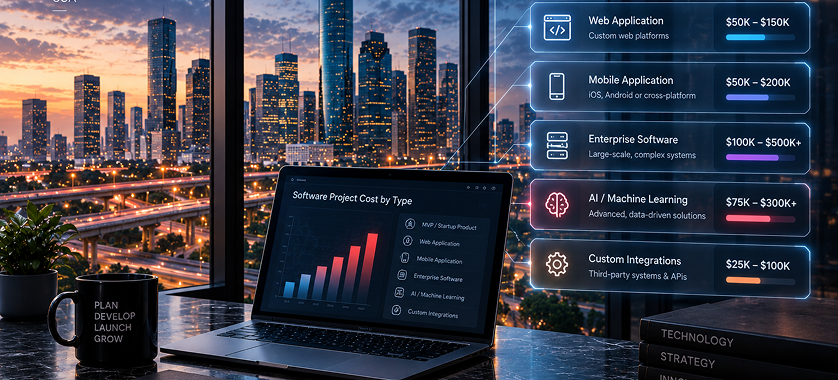
Rather than focusing only on a single dollar figure, consider the scope of the project.
Small Business Software
A smaller application might solve one clearly defined business problem.
Examples include:
- Internal workflow management
- Employee portals
- Simple CRM extensions
- Appointment management
- Inventory tools
- Reporting dashboards
These projects generally have fewer integrations, fewer workflows, and a smaller number of user roles.
The best approach is often to define a focused minimum viable product (MVP) rather than attempting to automate the entire organization immediately.
Mid-Sized Business Platforms
A mid-sized application may combine several business processes into one platform.
For example, a company could need:
- Customer management
- Order management
- Inventory tracking
- Employee workflows
- Reporting
- Billing integration
- Administrative controls
At this stage, architecture becomes increasingly important because the system needs to support several interconnected processes.
Enterprise Software
Enterprise projects can become substantially more complex.
They may involve:
- Multiple departments
- Complex permissions
- Large datasets
- Legacy-system integration
- Advanced analytics
- High availability
- Extensive security controls
- Multiple environments
- Automated deployment
- Detailed monitoring
- Data migration
The cost should therefore be evaluated as a business transformation project rather than simply a programming project.
What Is Included in the Cost of Custom Software?
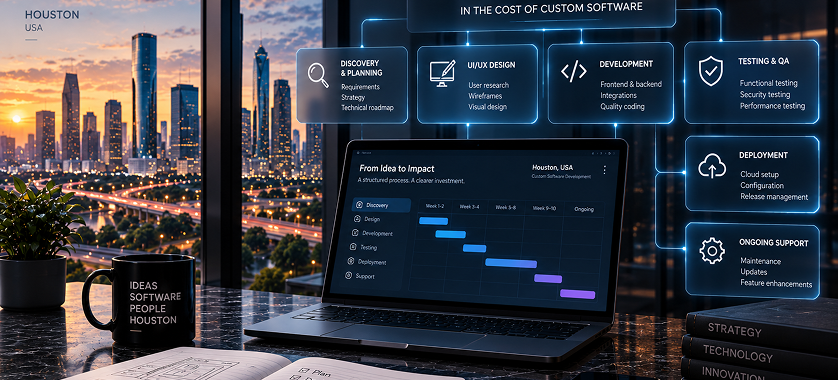
One common budgeting mistake is to consider only the development work.
A complete software project may include several stages.
Discovery and Requirements
Before development begins, the team needs to understand:
- Business objectives
- Current workflows
- User requirements
- Technical constraints
- Existing software
- Integration requirements
- Security considerations
Poorly defined requirements can lead to scope changes later.
UX and UI Design
This stage translates requirements into user flows, wireframes, interface designs, and prototypes.
Development
Developers then build the application, APIs, database architecture, integrations, and required functionality.
Quality Assurance
Testing can include:
- Functional testing
- Integration testing
- Security testing
- Performance testing
- Browser/device testing
- User acceptance testing
Deployment
The application needs an appropriate hosting and deployment environment.
Depending on the project, this could involve cloud infrastructure, CI/CD pipelines, monitoring, backups, and production configuration.
Maintenance
Software is not finished simply because it has launched.
Ongoing work may include:
- Security updates
- Bug fixes
- Performance improvements
- Infrastructure maintenance
- New features
- Third-party API changes
- Operating-system or browser compatibility
The total cost of ownership should therefore be considered alongside the initial development budget.
Hidden Costs Businesses Should Consider
The initial development estimate does not always represent the complete financial commitment.
Businesses should also consider:
Data Migration
Moving data from spreadsheets, legacy applications, or outdated databases can require significant cleanup and transformation.
Third-Party Services
Your software may depend on services for:
- Payments
- SMS
- Maps
- Cloud storage
- Analytics
- Authentication
- AI APIs
Some services introduce ongoing usage-based costs.
Cloud Infrastructure
Hosting expenses can vary depending on traffic, storage, databases, computing requirements, backups, and monitoring.
Future Changes
Business requirements rarely remain completely static.
A system may eventually need new integrations, reports, workflows, or customer-facing features.
A good architecture makes these changes easier to accommodate.
How Can You Reduce Custom Software Development Costs?
Reducing cost does not necessarily mean choosing the cheapest development option.
A better strategy is to reduce unnecessary scope while protecting the functionality that creates business value.
Start With the Most Important Workflow
Identify the problem that creates the greatest operational cost or inefficiency.
Build around that problem first.
Build an MVP
Instead of developing every possible feature, identify the minimum functionality needed to validate the solution.
For example, a logistics platform might initially focus on order management and dispatch before adding advanced analytics and automation.
Reuse Existing Services
There is no reason to rebuild every capability from scratch.
Existing APIs, cloud services, authentication systems, payment platforms, and other proven technologies can reduce development effort when they fit the requirements.
Plan Integrations Early
If the application depends on external systems, identify those dependencies during planning.
Discovering integration limitations halfway through development can create unexpected work.
Avoid Overengineering
Scalability is important, but building an extremely complex architecture before the business needs it can increase both development and maintenance costs.
The architecture should match the expected requirements and growth path.
How to Get an Accurate Software Development Estimate
If you want a meaningful estimate, provide a development team with more than a one-line project description.
A useful project brief should explain:
- Business problem — What are you trying to improve?
- Users — Who will use the software?
- Core workflows — What should users be able to do?
- Integrations — Which existing systems must connect?
- Platforms — Web, mobile, desktop, or multiple platforms?
- Data — What information will the system store or process?
- Security — What access and protection requirements exist?
- Scale — How many users or transactions are expected?
- Reporting — What dashboards or reports are required?
- Future plans — What features may be added later?
The more clearly these requirements are defined, the more useful the estimate becomes.
A good estimate should also explain what is included and excluded.
For example, two development proposals might appear similar in price, but one may include UX design, QA testing, deployment, and post-launch support while the other covers development only.
Should You Build Custom Software or Buy Existing Software?
Custom software is not automatically the best choice.
An off-the-shelf solution may be more appropriate when your processes closely match an existing platform and customization requirements are limited.
Custom development becomes more attractive when:
- Existing software forces inefficient workflows
- Multiple systems need to be integrated
- Your processes are highly specialized
- Automation could significantly reduce manual work
- You need complete control over the product
- Your software itself is a competitive advantage
- Existing platforms cannot scale with your requirements
The decision should be based on total cost of ownership and business value, not only the initial development quote.
Why the Cheapest Software Quote May Not Be the Cheapest Option
A low initial quote can become expensive if the project lacks:
- Clear requirements
- Proper architecture
- Testing
- Documentation
- Security planning
- Deployment processes
- Maintenance planning
Technical debt can make future changes slower and more expensive.
For business-critical software, it is often better to evaluate a development proposal based on quality, maintainability, security, communication, technical approach, and long-term ownership, in addition to price.
When Should a Houston Business Consider Custom Software?
Custom software can make sense when an existing system is actively limiting business operations.
For example, a Houston company may rely on spreadsheets and several disconnected applications. Employees may repeatedly copy information between systems, manually generate reports, or spend hours checking data.
If those processes occur every day, the business should calculate the operational cost of maintaining them.
A custom platform could potentially consolidate those workflows, automate repetitive tasks, and provide a centralized source of information.
The important question is not simply:
"How much does custom software cost?"
It is:
"What will the software cost, and what business problem will it solve?"
That distinction makes budgeting much more useful.
Conclusion
The cost of custom software development in Houston depends less on a simple hourly calculation and more on the complexity and business requirements behind the project.
A small internal application, an integrated business platform, and an enterprise SaaS product can have dramatically different development requirements. That's why businesses should define the problem, users, workflows, integrations, security needs, and future growth expectations before requesting a final estimate.
For Houston businesses considering a custom solution, the strongest starting point is a structured discovery process that connects technical requirements with measurable business objectives.
If your current systems no longer fit the way your business operates, you can learn more about custom software development in Houston and evaluate whether a custom solution makes sense for your organization.
EXTERNAL SOURCES
Source: National Institute of Standards and Technology (NIST) — Secure Software Development Framework URL: https://csrc.nist.gov/pubs/sp/800/218/final Claim Supported: Secure software development practices should be integrated into the software development lifecycle rather than treated as an afterthought.
Source: NIST — Secure Software Development Framework Project URL: https://csrc.nist.gov/projects/ssdf Claim Supported: NIST's SSDF provides practices for preparing organizations, protecting software, producing secure software, and responding to vulnerabilities.
Source: NIST — Developing Secure Products
URL: https://www.nist.gov/itl/smallbusinesscyber/guidance-topic/developing-secure-products
Claim Supported: Businesses should consider secure software development practices when developing software products.


 How much does custom software development cost in Houston?