
 EXIT
EXIT


 Menu
MenuChoosing between custom software and an off-the-shelf product is not simply a question of which option costs less. For a Houston business, the better choice depends on how unique your workflows are, how quickly you need the system, how many tools you need to connect, and whether the software supports an important competitive advantage.
Off-the-shelf software can be attractive because it is already built, tested, and available for use. A business can subscribe to a CRM, accounting platform, project management system, or other SaaS product without funding an entire development project.
Custom software takes a different approach. Instead of adapting your operations to a packaged product, the software is designed around your specific processes, users, integrations, and long-term requirements. IBM describes custom software as software designed for specific users, functions, or organizations, while commercial off-the-shelf software is designed for broader requirements.
So, in the custom software vs off the shelf decision, neither option is automatically better. The right answer depends on the problem your business is trying to solve.
For Houston companies in industries such as energy, logistics, healthcare, real estate, professional services, e-commerce, and manufacturing, that distinction can become particularly important when existing systems no longer fit the way the organization operates.
What Is the Difference Between Custom and Off-the-Shelf Software?
Custom software is purpose-built for a particular organization or business requirement. It can be designed around specific workflows, user roles, databases, APIs, integrations, reporting requirements, and security needs.
Off-the-shelf software is a ready-made product designed to serve a broad group of customers. Examples include standard CRM platforms, accounting applications, payroll systems, project management tools, communication platforms, and other SaaS products.
The fundamental difference is flexibility versus standardization.
With off-the-shelf software, you generally select a product first and then configure your business processes around its capabilities.
With custom software, the development process begins with your business requirements and creates the system around those requirements.
Neither model is inherently superior.
The key question is:
Is your business process common enough to use an existing product, or important and unique enough to justify building around it?
Custom Software vs Off the Shelf: A Side-by-Side Comparison
| Factor | Custom Software | Off-the-Shelf Software |
|---|---|---|
| Initial investment | Usually higher | Usually lower |
| Implementation | Requires planning and development | Often faster |
| Customization | High | Limited to available features |
| Business workflow fit | Designed around your process | Business adapts to the product |
| Integrations | Can be designed around required systems | Depends on available connectors/APIs |
| Scalability | Designed for expected requirements | Depends on vendor and plan |
| Updates | Business controls roadmap | Vendor controls roadmap |
| Maintenance | Business or development partner manages it | Vendor generally manages product |
| Vendor dependency | Can be reduced through ownership | Usually higher |
| Competitive differentiation | Strong potential | Usually limited |
| Time to deployment | Longer | Usually shorter |
| Best for | Unique or strategic workflows | Standard business processes |
The comparison shows why the decision should not be based only on the initial price.
A cheaper subscription can become expensive if employees spend significant time creating workarounds, entering the same data into multiple systems, or paying for several products because no single platform fits the complete workflow.
At the same time, building a custom application for a routine process that is already well served by a mature product can be unnecessary.
When Off-the-Shelf Software Makes More Sense
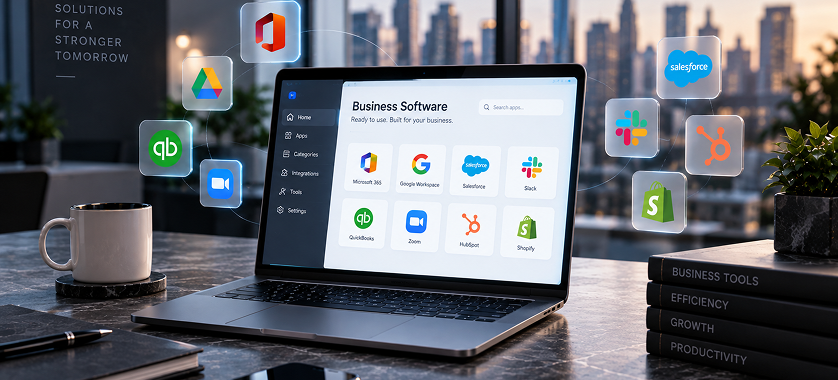
Off-the-shelf software is often the better choice when your requirements are common and well understood.
For example, a business usually does not need to build its own email platform, calendar application, basic accounting system, or standard document-management tool.
Buying an established product can provide:
- Faster implementation
- Lower initial development costs
- Existing functionality
- Vendor-managed updates
- Established support processes
- Existing integrations
- Predictable product features
Microsoft similarly identifies the trade-off: buying SaaS or off-the-shelf software can provide ready-to-use functionality and vendor-managed updates, while custom development offers greater tailoring but requires development, maintenance, and ongoing investment.
Choose off-the-shelf when your process is standard
Suppose a Houston professional-services company needs a basic CRM to manage contacts, sales opportunities, and follow-ups.
If an established CRM already provides these capabilities, developing a new CRM from scratch may create unnecessary cost and maintenance responsibilities.
The same principle applies to many common operational functions.
If the software is supporting a commodity business process rather than a differentiating process, buying may be the sensible option.
Off-the-shelf is also useful when speed matters
If a company needs a functioning solution immediately, an existing SaaS platform can often be configured much faster than a custom application can be designed, developed, tested, and deployed.
This matters when the business needs to solve an operational problem quickly and the available product already meets most requirements.
When Custom Software Is the Better Choice

Custom software becomes more attractive when existing products create significant compromises.
A business may have reached the point where employees are working around the software rather than using it to improve the workflow.
Typical warning signs include:
- Multiple disconnected systems
- Repeated manual data entry
- Spreadsheet-heavy processes
- Duplicate customer or operational data
- Expensive manual reporting
- Limited API access
- Critical workflows that cannot be automated
- Software limitations affecting customer experience
- Excessive customization of an existing platform
- Growing licensing costs
- A need for specialized business logic
In these situations, the question should not be simply, "How much does custom software cost?"
Instead, ask:
How much is the current way of working costing the business?
That includes employee time, errors, delays, missed opportunities, poor visibility, integration problems, and limitations on growth.
Houston Businesses May Have Complex Integration Needs
Houston businesses can operate across complicated workflows involving customers, vendors, employees, equipment, inventory, accounting systems, logistics platforms, and internal databases.
Consider a hypothetical Houston logistics company.
It may use separate systems for:
- Customer orders
- Inventory
- Dispatch
- Fleet information
- Billing
- Customer communication
- Management reporting
Each system might work adequately on its own.
The problem appears when employees have to manually transfer information between them.
A custom software solution could provide a central operational layer that connects these systems through APIs and automated workflows.
Instead of replacing every existing platform, the company could potentially integrate the systems that already work and build only the missing functionality.
This hybrid approach can sometimes be more practical than either completely buying or completely rebuilding.
Custom Software Can Support Unique Business Workflows
A major reason to consider custom development is that your process itself may be valuable.
Imagine a Houston energy-services company with a specialized process for scheduling field teams, tracking equipment, managing inspections, generating documentation, and communicating status to customers.
A generic application may support some of these activities but not the complete workflow.
Employees may then create spreadsheets, emails, manual approvals, and other workarounds to fill the gaps.
Custom software can encode the organization's actual workflow into the application.
That may include:
- Custom dashboards
- Role-based permissions
- Automated approvals
- Workflow automation
- Specialized calculations
- Custom reporting
- API integrations
- Customer portals
- Mobile applications
- Automated notifications
- Centralized databases
The objective is not to build software simply because customization is possible.
The objective is to remove meaningful operational friction.
Consider Total Cost of Ownership, Not Just the Purchase Price

One of the biggest mistakes in the custom software vs off the shelf decision is comparing only the initial costs.
Instead, consider the total cost of ownership (TCO).
For off-the-shelf software, the calculation may include:
- Monthly or annual subscriptions
- Per-user licensing
- Premium features
- Integration services
- Customization
- Data migration
- Training
- Additional software required to fill gaps
- Manual workarounds
- Vendor price increases
For custom software, consider:
- Discovery and requirements
- UI/UX design
- Development
- Testing
- Cloud infrastructure
- Security
- Deployment
- Maintenance
- Monitoring
- Future development
- Technical support
Custom software normally requires a larger initial investment, but the economics can change when a business has many users, complex workflows, or expensive integration problems.
NIST guidance on software package selection also recognizes that custom software generally has higher development costs, while extensive modification of packaged software can introduce its own complexity.
The correct comparison is therefore not:
Custom software = expensive
versus
Off-the-shelf = cheap
Instead, compare the expected costs and business value across the useful life of the solution.
Security Should Be Part of the Decision
Security should not be treated as something to consider after choosing the software.
For custom development, security should be addressed throughout the software development lifecycle.
NIST's Secure Software Development Framework recommends integrating secure development practices into software development processes to reduce vulnerabilities and their potential impact.
For a custom application, this can include:
- Secure authentication
- Role-based access control
- Data encryption
- Secure API design
- Input validation
- Logging and monitoring
- Vulnerability testing
- Secure deployment practices
- Regular maintenance and patching
Off-the-shelf software is not automatically insecure either. Established vendors may provide extensive security infrastructure and regular updates.
The important issue is understanding who is responsible for which security controls.
Before selecting either approach, Houston businesses should understand the application's data requirements, access model, integrations, regulatory obligations, backup strategy, and ongoing security responsibilities.
What About Scalability?
Scalability is another important consideration.
A small company might initially need a basic application with a few users and limited data. As the organization grows, however, its requirements can change.
More users may require:
- Better performance
- More powerful databases
- Additional automation
- New integrations
- Advanced reporting
- Different user roles
- Mobile access
- Customer-facing functionality
An off-the-shelf platform may scale successfully if its roadmap and architecture support those requirements.
However, the business remains dependent on the vendor's pricing, product roadmap, technical limitations, and integration capabilities.
Custom software gives the business more control over the architecture and future development path, but that control comes with responsibility for maintaining the system.
A Hybrid Approach Can Be the Best Option
The choice does not always have to be "build everything" or "buy everything."
A hybrid approach can combine existing products with custom software.
For example:
Buy:
- Accounting software
- Payroll
- Standard CRM functionality
Build:
- Specialized operations platform
- Customer portal
- Custom reporting
- Workflow automation
- Integration layer
This approach allows a business to avoid rebuilding mature commodity software while still solving the processes that existing products cannot handle effectively.
Microsoft's guidance on extending business platforms similarly emphasizes evaluating existing platform capabilities before building major custom functionality and considering the cost and complexity of extensions.
For many growing businesses, this can be a practical middle ground.
A Simple Framework for Choosing Between Custom and Off-the-Shelf Software
Before making a decision, score your situation against these questions.
1. Is the process standard?
If many businesses perform the same process in roughly the same way, an existing product may already be suitable.
If your workflow is highly specialized, custom development becomes more attractive.
2. Is the process strategically important?
If the software supports a process that directly differentiates your company, you should examine whether a generic product limits that advantage.
3. How many workarounds are required?
If employees constantly export spreadsheets, copy information between systems, or manually reconcile data, the real cost of the existing software may be higher than the subscription price suggests.
4. How important are integrations?
If your business depends on several systems communicating with each other, evaluate APIs, data ownership, integration capabilities, and automation requirements before choosing a platform.
5. How long will you use the solution?
A short-term operational need may favor buying.
A core system expected to support the business for many years may justify a more detailed custom-versus-buy analysis.
6. Who will maintain it?
Custom software requires an ongoing ownership strategy.
That means defining who handles:
- Bug fixes
- Security updates
- Infrastructure
- Monitoring
- Backups
- New features
- Technical documentation
If the organization cannot support those responsibilities internally, it should plan for a reliable development and maintenance partner.
Which Option Is Better for Houston Businesses?
There is no universal winner in the custom software vs off the shelf comparison.
Off-the-shelf software is usually better when:
- The process is common
- Speed is important
- The existing product meets most requirements
- The business wants vendor-managed updates
- Custom development would provide little strategic value
Custom software is usually worth evaluating when:
- Existing software does not fit the workflow
- Multiple systems need integration
- Manual processes are expensive
- The business has unique operational requirements
- The workflow provides competitive differentiation
- Scalability and long-term control are important
- Existing products require extensive customization
The best decision may also be a hybrid architecture where standard products handle commodity functions and custom software handles the business-specific requirements.
Conclusion
The decision between custom software and off-the-shelf software should be based on business requirements rather than the assumption that one approach is always better.
Off-the-shelf software can provide speed, established functionality, and vendor-managed maintenance for standardized processes. Custom software can provide greater control when your workflows, integrations, reporting requirements, or strategic processes do not fit existing products.
For Houston businesses, the strongest approach is often to identify which parts of the operation are commodity functions and which parts genuinely require differentiation. From there, compare the expected implementation effort, total cost of ownership, integration requirements, scalability, security responsibilities, and long-term business value.
If your existing tools are creating more work than they eliminate, it may be time to evaluate custom software development in Houston and determine whether a purpose-built solution makes financial and operational sense.
The goal is not simply to build software. It is to build or buy the right technology for the way your business actually operates.
EXTERNAL SOURCES
Source: NIST — Secure Software Development Framework (SSDF)
URL: https://csrc.nist.gov/pubs/sp/800/218/final
Claim Supported: Secure software development practices should be integrated throughout the software development lifecycle to reduce vulnerabilities and their potential impact.
Source: NIST — Guidance on Software Package Selection
URL: https://nvlpubs.nist.gov/nistpubs/Legacy/SP/nbsspecialpublication500-144.pdf
Claim Supported: Custom software generally involves greater development cost, while extensive customization of packaged software can introduce additional complexity and implementation considerations.
Source: Microsoft — Buy vs. Build
URL: https://www.microsoft.com/en-us/power-platform/blog/2025/02/05/agent-ready-data-management-dataverse/
Claim Supported: Custom development provides tailored functionality but involves development and ongoing maintenance, while off-the-shelf/SaaS products can provide ready-to-use functionality and vendor-managed updates.
Source: IBM — What Is Software Development?
URL: https://www.ibm.com/think/topics/software-development
Claim Supported: Custom software is designed for specific users, functions, or organizations, while commercial off-the-shelf software targets broader requirements.


 Is custom software better than off-the-shelf software?